What’s in this Post
Yellowstone National Park
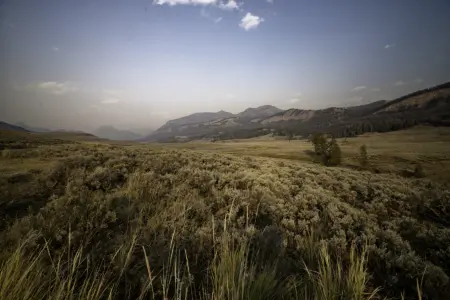 Have you ever wanted to photograph in a place that has it all? And I’m not talking about a place with a couple of animal species, and a few flowers. I’m talking about a place where there are literally hundreds of plant, bird and animal species, as well as numerous geographic elements and terrain. A place that might take you days, if not weeks, to explore. If you have, then Yellowstone National Park is the place for you.
Location
Yellowstone National Park is located primarily in Wyoming, but parts extend into Montana and Idaho as well. It was created by an act of the United States Congress in 1872, making it the first national park in the US, and possibly the world. The average elevation in the park is eight thousand feet. And it’s huge, covering approximately two million acres. It includes all of what is known as the Yellowstone Caldera. The caldera was the result of a super-volcano that erupted 640,000 years ago. A fair amount of time has passed, so another is due in the not-too-distant-future.
Entrances
The park has 5 gates or entrance stations. Generally, they are open 24 hours a day, 365 days a year. However, due to the elevation, weather can have a significant impact on gate access. Check with the park’s website for further information on weather conditions and closures before venturing anywhere in the park.
Entrance Fees
The fees are reasonable at $15 per week for an individual. A non-commercial vehicle with multiple passengers goes for $30 for a week. Please keep in mind that the rate can vary depending on the size of your vehicle, and whether you are interested in Grand Teton National park as well. Check the Park’s webpage, read the signs, or talk with the park Rangers, for further information.
Weather
The weather in the park varies significantly from season to season. Average temperatures range from a low of -15 degrees (Celsius) in the winter, to a high of 25 degrees (Celsius) in summer. Check the park’s website pages, or the weather on your favorite weather website for specifics.
Size
As mentioned, the park is rather large, so expect to drive everywhere. The main road system is entirely paved, and well maintained. But note that the road system only covers a small percentage of the park. There are two loops, north and south, providing access to the interior, linking the main attractions, and connecting the loops to each gate. Beyond that there are a number of secondary roads that are primarily gravel.
Wildlife
You are free to go almost anywhere in the park. This can be a blessing, and a curse. The park is wild, the animals are wild, and the weather is unforgiving. So be very, very careful. If you don’t know what you are doing, then stay in your car. Wolves, black bears, grizzly bears, elk, and bison roam freely in the park. And they can be very, very dangerous. If you don’t believe me, just take a look at some of the Wildlife Safety Videos on the park’s website.
Photography
The park is truly a photographer’s dream location. No matter where you go, you find an interesting sight to take in and enjoy; incredible mountains, deep majestic canyons, dense green forests, clear blue streams and lakes, rolling hills, and serene meadows. For example, before you enter the north gate, you will pass through the town of Gardiner. In the background, you will see the incredible mountain vista and Mount Everts. The north-east gate leads to the town of Silver gate and the dense forests as you exit the park. Through the east gate, it is several kilometers (miles) to the town of Cody. And finally, through the south gate, it is a short drive to Grand Teton National Park, with the majestic Teton mountains as a highlight.
Thermal Features
The park is also home to many thermal features. Old Faithful (geyser), and the Mammoth Hot Springs, immediately come to mind. These areas evidence the volcanic activity that affected this area thousands of years ago.
Conclusion
Yellowstone National Park is a wonderful place to take photographs. With a wide variety of geography and wildlife to choose from, you are sure to find what you are after. But be careful. The park is not a zoo, so the animals live and roam freely within its borders. They will protect themselves, sometimes violently, if threatened.

Dave’s Newsletter
Discover the thrill of the great outdoors on my adventure website. Explore breathtaking hiking trails, conquer rugged terrain on your mountain bike, or capture nature’s beauty with your camera. All from your inbox. Adventure awaits!