What’s in this Post
The Exposure Triangle
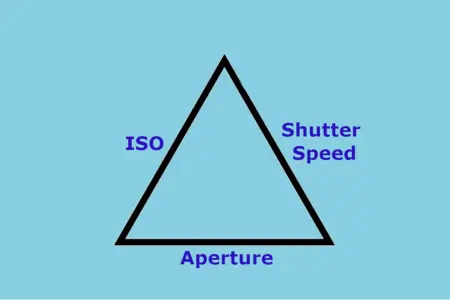 The Exposure Triangle is everything in photography. We spend our entire careers searching for, and adjusting, the light in our images. So much so, in fact, that we can become obsessed. And rightly so.
Correct Exposure
A question I often hear is, what does the phrase “correct exposure” mean? This isn’t so easy to answer. In fact, I’ve heard a number of explanations over the years. Some were technical, some were not. The best one, I think, goes like this:
“The correct exposure is one where the overall image brightness preserves as much highlight detail as possible, and as much shadow detail as possible.”
Think of it as a balancing act. Add more light (brightness), and you lose highlight detail (over exposure). Remove light, and you lose shadow detail (under exposure). Not too bad! But just wait, it gets worse.
Aperture, shutter speed, and ISO must work together because they make up the Exposure Triangle.
Aperture
An aperture is the opening in a lens. It allows light to strike the film plane or sensor, and is measured in F-stops. The “F” in F-stop stands for focal length, and an F-stop is the ratio of focal length over the diameter of the aperture. Values, such as f/2.8, f/4, f/5.6, f/8, etc., are representative. The smaller the value, the bigger the opening. Each step, up or down, represents a halving, or doubling, of the light allowed through the lens.
Shutter Speed
Shutter speed is the length of time the light is allowed to pass through the lens. It is measured in seconds, or fractions of a second. Common shutter speed values include 1, 2, 4, 8, 16, etc. Inverting these values (1, 1/2, 1/4, 1/8, 1/16, etc.) determines the actual shutter speed. So, each step, up or down, represents a halving, or doubling, of the light allowed through the lens.
ISO
ISO is an acronym that stands for International Standards Organization. It is a measure of how easy it is to capture the light that falls upon the film or sensor. Common ISO values include 100, 200, 400, 800, 1600, etc. Each step, up or down, represents a halving, or doubling, of the light sensitivity. The higher the value, the more easily the film or sensor can be exposed. Looking at it another way, the higher the value, the lower light conditions you can take pictures in.
All this great. But it gets confusing when you consider that for most images, there is more than one Exposure Triangle (Aperture, Shutter Speed, and ISO) combination that will give you a correct exposure. The difference between them is Depth-of-field, or the amount of subject matter in focus, in front of, and behind the principle subject. It is directly controlled by the size of the aperture selected. The bigger the f-stop, the larger the depth-of-field. Interestingly enough, the triangle value are not independent. Adjusting one, will affect one or more of the others.
Creativity
This is where the creative aspects of the photography come in to play. Controlling depth-of-field can drastically change the visual impact of an image. For example, let’s say you wanted to take a portrait of a bird in its natural environment. A large aperture value (small opening) will increase the depth-of-field and place more of the background in focus. The end result is that the bird won’t be a significant in the frame. Conversely, a small aperture value (large opening) will blur the background, and keep the bird in focus. The end result is that the bird will stand out in the frame.
Get the idea?
Conclusion
Unlike most techniques, the Exposure Triangle is central to photography.

Dave’s Newsletter
Discover the thrill of the great outdoors on my adventure website. Explore breathtaking hiking trails, conquer rugged terrain on your mountain bike, or capture nature’s beauty with your camera. All from your inbox. Adventure awaits!